Linked, and no two of them are
Worth reading first: Zero can mean two different things · A loop that cannot be pulled tight.
Two loops and one number attaches an integer to a pair of loops in space, computed by adding signs over the crossings between them and halving. It is unchanged by any deformation, it distinguishes the Hopf link from two separate circles, and it is the first invariant of links anybody meets.
Zero can mean two different things shows one way it fails: a loop can pass through another’s spanning disc twice in opposite directions, giving zero, and that zero really does mean the loops come apart. Here is the other way it fails, and this time the zero is a lie.

The three rings cannot be separated. Remove any one and the other two fall apart.
The property, and what it is called
A link with this behaviour — not separable, but separable after the removal of any single component — is called Brunnian, after Hermann Brunn, who described such things in 1892. The Borromean rings are the smallest example, and they turn up in heraldry and on cathedral floors long before anyone asked whether they could be pulled apart.
The Brunnian property is what makes the linking number’s failure structural rather than accidental. The linking number is defined on pairs, and every pair here is an unlink; so any invariant computed pair by pair must return the same answers as for three separate circles.


So the question is not whether the linking number happens to miss this link. The question is what kind of invariant could possibly see it.
Where the missing information went
The linking number of with has a reading that makes the loss visible. Delete from space. What is left has a fundamental group, and if is an unknotted circle that group is infinite cyclic — generated by a small loop encircling once. The class of in that group is an integer, and it is the linking number.
Now delete two components and ask about the third. The complement of two circles that are not linked to each other has fundamental group free on two generators — one meridian for each — and the third component’s class is an element of that free group rather than an integer.
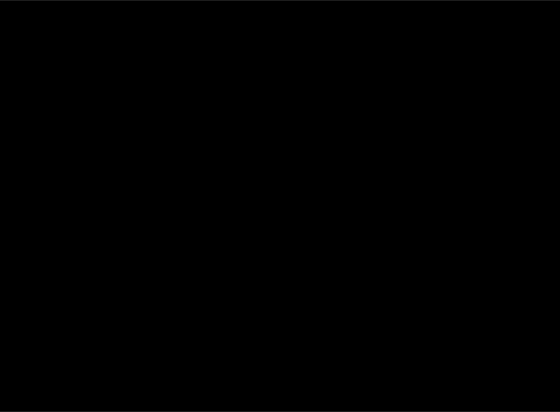
The two linking numbers of the third component with the other two are the exponent sums of that word — how many ’s net, how many ’s net. And an exponent sum throws away the order of the letters.
That is the loss, stated exactly. The linking numbers are what survives forgetting the order in which the third ring goes round the other two, and for the Borromean rings the order is all there is.
The word, in a plane with two holes
The free group on two generators is easiest to meet where it can be computed: a plane with two points removed. A closed curve there has a class in the free group, read by drawing a cut out from each hole and recording a letter each time the curve crosses a cut.
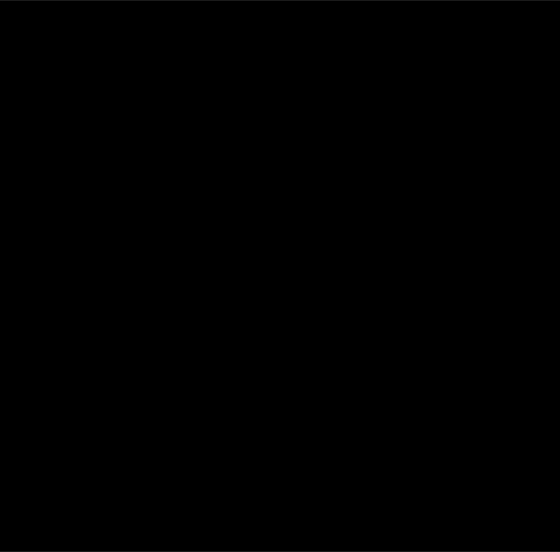
The curve drawn there is the commutator . It goes round the left hole once forwards and once backwards, and the same for the right, so both winding numbers are zero. And it cannot be pulled tight, because is not the identity in a free group — the whole point of a free group being that no relation holds beyond the ones forced.

A curve with every winding number zero that cannot be pulled tight, beside a link with every linking number zero that comes apart. That is the whole difference between the Borromean rings and three separate circles, met once in a plane where it can be computed and once where it started.
Putting the two together
Delete ring 3 from the Borromean rings. Rings 1 and 2 are then a two-component unlink, and the complement of an unlink collapses onto a wedge of two circles — so ring 3 traces a loop whose class is a word in and .
That word is the commutator. Its exponent sums are zero, which is why both linking numbers vanish; it is not the identity, which is why the rings cannot be separated. If the rings were separable, ring 3 could be pulled clear of the other two, and its class would be trivial.
The invariant that sees the link is the class itself, and the linking numbers are its shadow after the order is forgotten.
Milnor formalised this in 1954 into a family of invariants — the invariants — obtained by reading the class in successive quotients of the free group by the terms of its lower central series. The first-order invariants are the linking numbers; the next order sees commutators, and the Borromean triple invariant is the first one that is not a linking number. The construction goes on, and each order sees links the previous ones miss.
Why three rings and not two
There is no two-component Brunnian link, and the reason is a good check on the whole account.
For two components, “separable after removing any one” says nothing — remove one and a single circle is left, which is separable from nothing. So the Brunnian condition on a two-component link is just that it is not separable, and the linking number often catches that. It does not always: the Whitehead link has linking number zero and is not separable.
The Whitehead link is therefore the two-component analogue of the situation here, and it needs a different invariant again — Milnor’s , which reads the class in a deeper quotient than the triple invariant does. Its complement’s fundamental group is not free on two generators, because the two components are not an unlink after one is deleted; they are, but the way the remaining one sits is what carries the information.
So the pattern is: with two components the first failure of the linking number needs a fourth-order invariant, and with three it needs only a third-order one. More components make the first interesting invariant simpler, which is the reverse of what one would guess and is the reason the Borromean rings, rather than the Whitehead link, are the standard illustration.

A trap this essay fell into
The first attempt at computing the word did it on the link diagram directly: walk the third component, and write a letter for each pass underneath one of the other two, with the crossing’s sign.
That reading is wrong, and wrong quietly. It returned for the Borromean rings, which cancels, and would have reported them unlinked.
The reason is worth stating because it is a general trap. The letters of a link diagram’s Wirtinger presentation are meridians of individual arcs, and the arcs of one component are conjugates of each other rather than equal — related by the relations at each crossing. So writing for two different arcs of component 2 identifies two group elements that are conjugate and not equal, and a product like collapses to nothing under that identification while being perfectly non-trivial in the group.
A shortcut that ignores conjugation returns the abelianisation and calls it the group — and the abelianisation is exactly where the linking numbers live, so the shortcut is guaranteed to reproduce the invariant it was meant to improve on. The planar figures above have no arcs to conjugate by, which is why they compute the right thing.
Winding number is the same shadow, one dimension down
The plane figures make a point that is worth separating from the link, because it is the same phenomenon in a setting with no knotting in it at all.
A closed curve in a plane with two holes has two winding numbers, and they are the exponent sums of its word. Two curves with the same pair of winding numbers can be genuinely different loops, and the commutator is the smallest example: winding numbers , and not contractible.

So the failure of the linking number is not a fact about three dimensions or about knots. It is the fact that a group’s abelianisation loses everything a commutator carries, and it shows up wherever a non-abelian group is summarised by counting.
That gives a rule of thumb for reading any invariant of this kind. Ask what group the invariant is really a homomorphism out of, and whether that group is abelian. If it is, the invariant cannot distinguish two things whose difference is a commutator — and if the objects in question have a non-abelian symmetry anywhere in them, such pairs exist and will eventually be met.
Higher orders, and where they stop
Milnor’s construction is a ladder rather than a single invariant, and the rungs are the terms of the lower central series.
Start with the free group on the meridians. Its abelianisation is where the linking numbers live. The next quotient, , keeps commutators of two elements while killing commutators of commutators — and the Borromean triple lives there. The next keeps triple commutators, and sees links that three-component invariants miss.
There is a Brunnian link of components for every , made by nesting the Borromean idea, and each needs an invariant of order to be seen. So no finite level of the ladder detects all links, and each level is genuinely needed.
The invariants come with a caveat that is in the notation: rather than . The higher ones are only well defined modulo the lower ones — a link’s triple invariant is an integer only when its linking numbers all vanish, and otherwise is defined modulo their greatest common divisor. That is not a technical blemish; it says the ladder’s rungs are not independent, and each is a statement about the link given what the earlier rungs said.
Where this sits among the other invariants
Colours that count more than three uses Fox colourings, which are counts of homomorphisms from the fundamental group onto a small structure, and which do distinguish some links the linking number misses. They do not see the Borromean rings either: the group of the complement surjects onto the free group’s abelianisation and every Fox colouring factors through something too coarse.
The subgroup that is freer than the group works with the same free groups and asks a different question about them — how a subgroup’s rank compares with its index. The object is shared and the questions are unrelated, which is the usual situation.
And the crossings that will not come out even is the closest neighbour in spirit. There, a count of crossings is not an invariant and its parity is, and the parity survives because the moves that change the count change it by two. Here, a count of crossings is an invariant and it is not enough, and what is needed is the thing the count was an abbreviation of.
Three rings that cannot be round
The picture at the top draws the rings as three ellipses, and that is not a stylistic choice about how they fit on a page. No arrangement of three geometrically round circles in space is the Borromean link. Freedman and Skora proved it in 1987, and the result is stronger: no Brunnian link at all can be built from round circles.
The obstruction is a piece of geometry rather than of topology, which is what makes it worth having here. A round circle in space bounds a flat disc, and two round circles that are not linked can be separated by a plane or else one passes through the other’s disc — the possible configurations of round circles are far more rigid than the possible configurations of loops. The rings can be made from three ellipses of any eccentricity, however slight, and they cannot be made from three circles: an arbitrarily small deformation is required and nothing less will do.
That is a good corrective to how these pictures are usually read. Every figure in this essay is drawn in a particular position, and the invariants computed from it are properties of the link and not of the drawing — that is the whole point of an invariant. But the drawings also carry accidental geometric facts, and the roundness of a curve is one of them. A property invariant under deformation can still be impossible to realise with a restricted class of shapes, and confusing the two is how a reader concludes that the standard heraldic device is drawn badly.
The same pattern where nothing is knotted
The arrangement has a name outside topology, and the physics is close enough that the name was borrowed rather than coined.
A Borromean nucleus is a bound three-body system none of whose two-body subsystems is bound. Helium-6 is the standard case: an alpha particle and two neutrons, held together, while an alpha and a single neutron do not bind and two neutrons do not bind either. Remove any one of the three and the remaining pair falls apart — which is the Brunnian condition stated about binding energy instead of about isotopy.
Efimov predicted in 1970 that such three-body states not only exist but come in an infinite sequence with geometrically spaced energies, appearing exactly when the two-body attraction is tuned to the edge of binding, and the states were found in cold-atom experiments from 2006 onwards. Nothing in that is topology; there is no link, no complement and no fundamental group. What the two situations share is the logical shape — a property of a triple that no pair possesses — and the reason it feels surprising in both places is the same habit of assuming that what is true of a whole is assembled out of what is true of its parts.
That habit is exactly what the linking number encodes. It is a pairwise measurement, so it can only ever report a sum of pairwise facts, and a triple with no pairwise content is invisible to it by construction rather than by accident.
What the pictures cannot show
The three rings are drawn as three ellipses in mutually perpendicular planes, which is one realisation of the link among many. Nothing in the picture indicates that the property is a property of the link rather than of this arrangement, and a differently drawn Borromean link would have different crossing counts with the same linking numbers.
The planar figures compute in the free group on two generators, and the step connecting them to the rings — that the complement of an unlink collapses onto a wedge of two circles, and that ring 3 becomes such a curve — is asserted in prose and drawn nowhere. It is the one step of the argument the figures do not perform, and it is a genuine step: the collapse is a deformation retraction of a three-dimensional complement, and no plane picture is it.
And the Brunnian property itself is not computed anywhere here. That every pair of the three rings really is an unlink — rather than merely having linking number zero — is stated and is not established by the linking numbers, which is the essay’s own point used against itself.
The ladder from here
Below: two loops and one number, which builds the linking number two ways, and zero can mean two different things, the other way it fails. Sideways: a loop that cannot be pulled tight, where a fundamental group first does this kind of work, and the same loop unrolled, which relates a loop’s class to a covering. Above: Milnor’s higher invariants, Massey products, the lower central series of a link group, and finite-type invariants, which contain all of these.
What is worth carrying away
An invariant is a way of forgetting, and the useful ones forget exactly enough. The linking number forgets the order of the letters, which is the right thing to forget when the answer is a single number and the wrong thing when the whole content is that .
So the failure is not a defect to be patched. The linking number is the abelianisation of a genuine invariant, and everything it misses is a commutator — which is a complete description of its blind spot, and a recipe for the next invariant along. The pattern recurs: whenever a numerical invariant is a count, it is worth asking what it is counting in, because the thing it counts in is usually a group, and the group usually knows more.
Where this goes next
 Zero can mean two different things
The linking number counts how often one loop pierces a surface the other one bounds. Two punctures of opposite sign add to nothing, and a loop that never goes through adds to nothing as well — so the answer zero is two pictures wearing one number.
Zero can mean two different things
The linking number counts how often one loop pierces a surface the other one bounds. Two punctures of opposite sign add to nothing, and a loop that never goes through adds to nothing as well — so the answer zero is two pictures wearing one number.
 The subgroup that is freer than the group
A free group on two letters contains a subgroup of index three that is free on four. Nothing about a group makes that plausible; everything about a graph makes it obvious, and the argument is to stop looking at the group and start looking at the space whose loops it is.
The subgroup that is freer than the group
A free group on two letters contains a subgroup of index three that is free on four. Nothing about a group makes that plausible; everything about a graph makes it obvious, and the argument is to stop looking at the group and start looking at the space whose loops it is.
 The crossings that will not come out even
Draw a rearrangement as strings from one row of pegs to another and count where they cross. The count depends on how the strings are drawn; whether it is odd or even does not, and that single bit is what makes determinants exist and a sliding puzzle unsolvable.
The crossings that will not come out even
Draw a rearrangement as strings from one row of pegs to another and count where they cross. The count depends on how the strings are drawn; whether it is odd or even does not, and that single bit is what makes determinants exist and a sliding puzzle unsolvable.
What links here
Computed from the collection, not written here: the essays that point at this one.
Shares its objects with
Essays that name at least two of the same things, and that neither author linked.
- How a random path winds round a point — both name free group, fundamental group, winding number
- What homology forgets about a loop — both name commutator, free group, fundamental group
- A covering is a permutation — both name free group, fundamental group
- Cutting a space to find its group — both name free group, fundamental group
- Every cover is a subgroup — both name fundamental group, winding number
- The group a space has at a point — both name fundamental group, winding number
Named objects
A dashed tag is an object no other essay names yet.
Borromean ringsBrunnian linkCommutatorFree groupFundamental groupLinking numberMilnor invariantWinding number